
Environmental Group Estimator
How many environmental groups exist near you?
Based on data from the article, this tool estimates the number of environmental groups in your region. Note: Actual numbers vary widely due to informal groups and local variations.
Estimated Results
Enter your region and group type to see the estimate.
Why this estimate? The article shows numbers vary widely because many groups operate informally. These estimates are based on official counts from the article, but real numbers may be higher.
There’s no single number for how many environmental groups exist - not because the count is secret, but because the landscape is messy, growing, and deeply local. You’ve got global giants like Greenpeace and the World Wildlife Fund, but also a backyard group in Bristol that plants trees along the Avon, a youth collective in Manchester that pressures local councils on plastic waste, and a Native-led team in Alaska fighting oil drilling on ancestral land. All of them count. So instead of giving you a fake total, here’s what actually matters: the types of environmental groups, what they do, and how many you’re likely to find in your own region.
Four Main Types of Environmental Groups
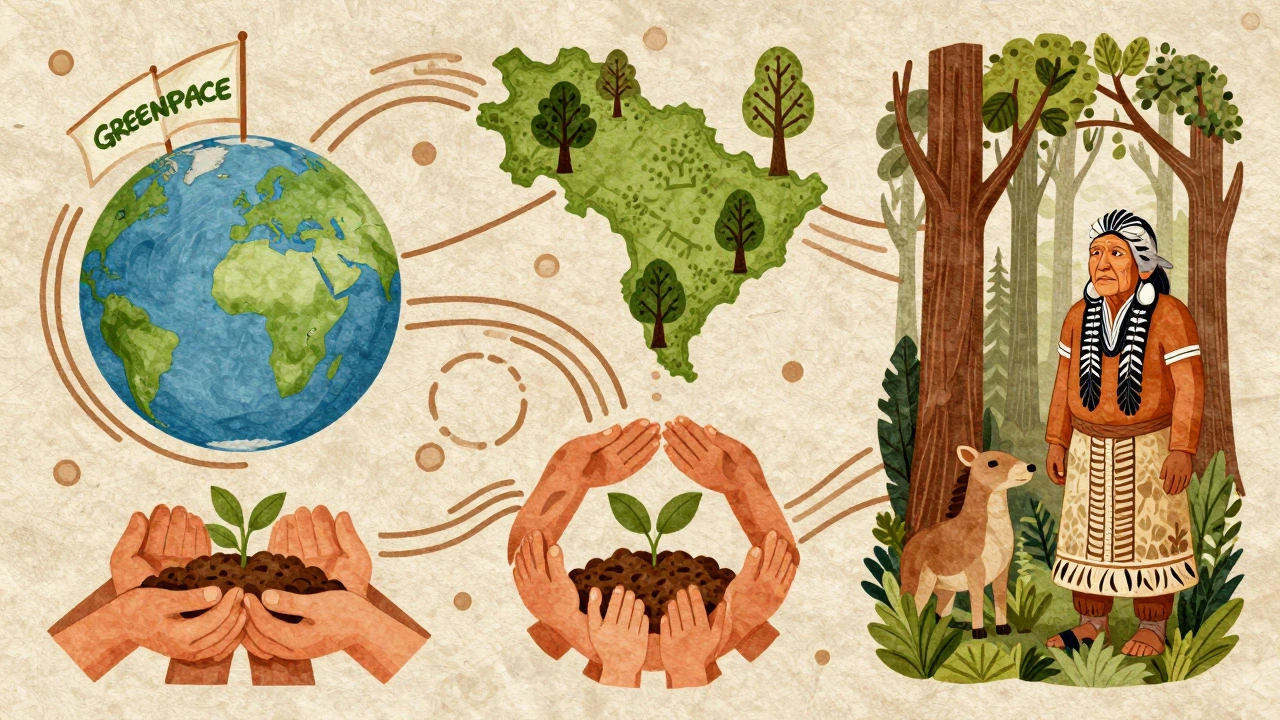
Environmental groups aren’t all the same. They fall into four broad buckets, each with different goals, funding, and reach.
- International NGOs - These are the big names you see on TV. Groups like Greenpeace, WWF, and Friends of the Earth operate across dozens of countries. They run global campaigns, lobby the UN, and fund large-scale research. There are about 30 major ones globally that have offices in over 10 countries and annual budgets over $50 million.
- National NGOs - These work within one country. In the U.S., you’ve got the Sierra Club and Natural Resources Defense Council. In the UK, it’s the RSPB and the Environmental Defense Fund UK. These groups often have thousands of members, run national petitions, and influence national policy. There are roughly 150 to 200 active national environmental NGOs across developed countries.
- Community-based organizations - These are the quiet heroes. A group of neighbors in Bristol who clean up the river every Saturday. A church in Leeds that started a composting program. A high school in Cardiff that tracks air quality near their campus. These groups don’t have websites or staff - just passion. No one keeps a full list, but experts estimate there are over 100,000 of these small groups worldwide, with at least 5,000 in the UK alone.
- Indigenous and land-based groups - These organizations are led by Indigenous communities defending their land from mining, logging, or pipelines. Examples include the Standing Rock Sioux Tribe’s water protectors or the Guna Yala people in Panama stopping illegal deforestation. There are over 2,000 such groups globally, many unrecognized by governments but vital to biodiversity. In the UK, this includes groups like the Gypsy, Roma, and Traveller communities protecting green spaces from development.
Why the Numbers Don’t Add Up
You might think a government or charity watchdog tracks every environmental group. They don’t. Why? Because most don’t register as charities. Many operate under local community associations, school clubs, or even informal Facebook groups. A group that plants 50 trees in a park doesn’t need to file paperwork - it just shows up with shovels.
Even when they do register, the rules vary. In the UK, if a group raises under £5,000 a year, it doesn’t have to register with the Charity Commission. That means thousands of groups fly under the radar. A 2024 study by the University of Bristol found that only 12% of active environmental groups in the South West were officially registered as charities. The rest? Just people doing what they think is right.
How Many Are Active Right Now?
Let’s break it down by scale:
- Global: Around 50 major international NGOs
- National: Roughly 250 in Europe, 300 in North America, 150 in Australia and New Zealand - total around 700
- Local: Conservative estimate: 150,000 worldwide. In the UK alone, a 2025 survey by the Environmental Information Service found 8,200 active local groups - up 22% from 2020
- Indigenous: Over 2,000 documented, but likely closer to 3,000 when informal networks are included
That’s at least 160,000 environmental groups actively working right now - and that’s just the ones we know about.
What’s Driving the Growth?
More people are starting groups than ever before. Why? Three big reasons:
- Climate anxiety - Young people, especially, aren’t waiting for governments to act. They’re forming groups to plant trees, ban single-use cups in cafés, or demand solar panels on school roofs.
- Access to tools - Free platforms like Meetup, Canva, and Google Forms make it easy to organize. You don’t need a budget to start a petition or a clean-up day.
- Local impact feels real - People see that fixing a polluted stream in their town matters more than signing a global petition. Local action builds community, and that’s powerful.
In Bristol, for example, the number of environmental groups listed on the city council’s community portal jumped from 120 in 2021 to 215 in 2025. Most are under 10 people. None have full-time staff. But they’re planting 10,000 native saplings a year, running repair cafes, and training kids to monitor water quality.
How to Find Groups Near You
If you want to join or start one, here’s where to look:
- Local council websites - Most have a ‘community groups’ or ‘environment’ section
- Meetup.com - Search for ‘environment’, ‘climate’, or ‘nature’ in your city
- Volunteer platforms - Do-It.org (UK) and VolunteerMatch (US) list local environmental opportunities
- Libraries and community centers - They often have bulletin boards with flyers from local groups
- Ask at independent cafes - Many have community boards, and environmental groups love to post there
Don’t wait for the perfect group. If you care about bees, start a bee-friendly garden club. If you hate plastic packaging, organize a bulk-buying group with neighbors. You don’t need a logo. You just need to show up.
What You Can Do Today
You don’t need to join a big organization to make a difference. Here’s what you can do in the next 24 hours:
- Walk around your neighborhood and note one place that’s littered or overgrown. Take a photo.
- Text three friends: ‘Want to clean this up next Saturday?’
- Use a free template from the UK’s Keep Britain Tidy website to make a simple flyer.
- Meet at the spot. Bring gloves, bags, and maybe a thermos of tea.
- Post a picture. Tag your local council. That’s your group now.
That’s how most environmental groups start. Not with a mission statement. Not with a grant. Just with one person saying, ‘This shouldn’t be like this.’
Are all environmental groups charities?
No. Only about 10-15% of environmental groups in the UK are registered charities. Many operate as informal community groups, school clubs, or unincorporated associations. They don’t need charity status to plant trees, run clean-ups, or campaign locally. Registration only matters if they’re raising over £5,000 a year or want to apply for certain grants.
How do I start my own environmental group?
Start small. Pick one issue you care about - litter, noise pollution, lack of green space, etc. Talk to five people who feel the same. Pick a time and place to meet. Use free tools: Google Forms for sign-ups, Canva for posters, Facebook Events for promotion. You don’t need a name, a website, or funding. Just show up, do the work, and let the group grow from there. Many of the most effective groups never had a budget.
Do environmental groups actually make a difference?
Yes - especially local ones. A 2023 study from the University of Oxford found that community-led environmental projects were 3x more likely to be sustained over five years than top-down government programs. Local groups know their area, build trust, and adapt quickly. For example, a group in Cornwall stopped plastic microbeads in local cosmetics by convincing three small shops to switch suppliers - and the brand eventually changed its formula nationwide.
Are there environmental groups for kids and teens?
Absolutely. Groups like the Young Environmentalists Network (YEN) and Eco-Schools UK are active in over 1,200 schools. Teens lead campaigns on everything from banning balloons at parties to installing water refill stations. Many local councils now fund youth environmental projects - you just have to ask. Start by talking to your school’s head of science or PE - they often know about existing clubs.
What’s the difference between an environmental group and a conservation group?
There’s overlap, but the focus differs. Conservation groups mainly protect wildlife and natural habitats - think RSPB protecting birds or the National Trust managing ancient woodlands. Environmental groups have a broader scope: they tackle pollution, climate change, waste, energy use, and social justice. Most environmental groups include conservation work, but not all conservation groups address things like plastic packaging or air quality laws.
What Comes Next?
The number of environmental groups isn’t what matters. What matters is that they’re everywhere - in cities, towns, villages, and even online. You don’t need to wait for someone else to fix things. You’re already part of the solution, whether you realize it or not. If you’ve ever picked up litter, switched off a light, or told a friend about a recycling rule, you’re already in the movement.
There’s no finish line. But there are plenty of people ready to walk beside you - if you just take the first step.