
Charity Marketing Strategy Planner
Product
The solution you offer to beneficiaries and donors.
Price
Monetary cost + time/emotional friction for stakeholders.
Place
Where your audience interacts with you (digital/physical).
Promotion
Storytelling channels that drive awareness and action.
Define Your Strategy
Answer these questions to audit your current approach based on the article's framework.
Action Plan
Potential Pitfalls
Quick Checklist for Implementation
You’ve probably heard the term "marketing" thrown around in board meetings or seen it plastered across job descriptions. But when you’re running a charity-whether it’s a small local food bank in Bristol or a national animal rescue-the word can feel dirty. It sounds corporate, cold, and disconnected from the heart-warming work you actually do. Here is the truth: charity marketing isn’t about selling out; it’s about speaking up so people know you exist.
If you are trying to figure out how to get more donors, volunteers, or event attendees, you need a framework that makes sense without requiring an MBA. Enter the 4 P’s. Originally designed for businesses, this model translates surprisingly well to the non-profit world. It stops you from guessing what works and starts giving you a checklist for impact. Let’s break down what the 4 P’s of a charity actually mean and how you can use them right now.
Product: What Are You Actually Offering?
In the business world, "product" means the thing on the shelf. In a charity, it’s trickier. You aren’t selling a physical item, but you are offering something valuable. Think of your product as the solution you provide to a specific problem. If you run a youth center, your product isn’t just the building; it’s the safe space, the mentorship, and the skills training. For a donor, the "product" they buy with their money is the feeling of making a difference and the tangible result of that donation.
This distinction matters because many charities fail by focusing only on their internal operations rather than the external benefit. Ask yourself: What does the beneficiary get? What does the donor get? If you host a gala dinner, the product for the attendee is entertainment, networking, and social status, not just the soup they eat. If you launch a crowdfunding campaign for new shoes for homeless teens, the product is the transformation of those kids’ confidence.
To refine your product, be specific. Vague promises like "helping people" don’t stick. Concrete offers like "providing 50 hot meals per day at St. Jude’s Shelter" create a clear mental image. Your product must solve a pain point. For beneficiaries, the pain might be hunger or isolation. For donors, the pain might be a desire for community connection or tax benefits. Align your offerings with these needs.
Price: The Cost of Giving (And Receiving)
When most people hear "price," they think of dollars and cents. But in charity, price is multi-dimensional. Yes, there is the monetary cost-how much you ask for in donations or ticket prices for events. But there is also the psychological and time cost. This is often where charities stumble.
Consider the "cost" to a volunteer. If you ask someone to commit to every Saturday morning for six months, that’s a high price in terms of time and energy. If you make it too easy-like asking for one hour once a year-you lower the barrier, but you might get less commitment. Finding the sweet spot is crucial.
| Stakeholder | Monetary Price | Non-Monetary Price | Value Proposition |
|---|---|---|---|
| Donor | £10 monthly gift | Time to fill forms; emotional vulnerability | Guilt relief; tax deduction; sense of agency |
| Volunteer | Travel costs | Free weekends; learning curve | Skill acquisition; community belonging |
| Beneficiary | None (usually free) | Dignity risk; waiting times; paperwork | Access to resources; hope; stability |
| Partner/Sponsor | Sponsorship fee | Brand alignment risks; staff time | CSR credentials; positive PR exposure |
Notice how the "price" for a beneficiary includes dignity? If your intake process for a food bank feels bureaucratic and judgmental, the non-monetary price is too high. People will avoid your service even if it’s free. Always audit the friction points. How hard is it to donate? How confusing is the website? High friction equals high perceived price.
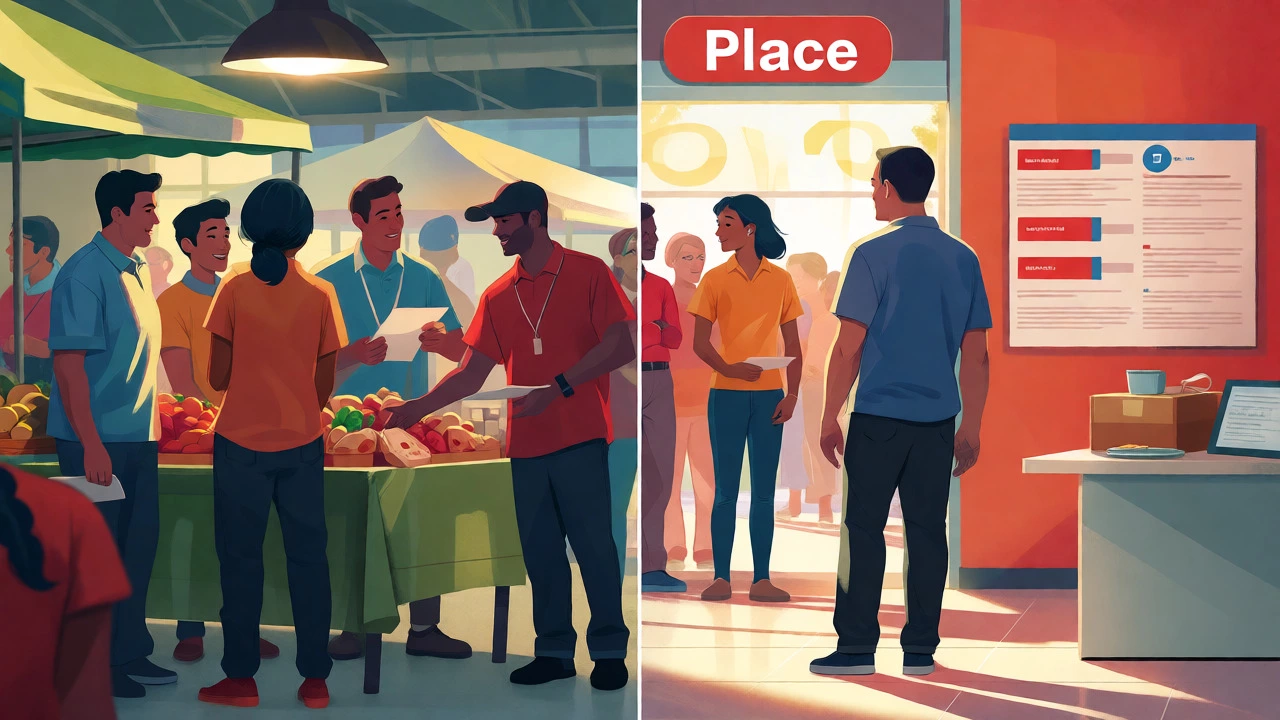
Place: Where Do You Meet Your Audience?
Place isn’t just about geography. It’s about accessibility and visibility. Where does your target audience hang out? If you are targeting Gen Z donors, your "place" is Instagram and TikTok, not a printed newsletter. If you are helping elderly residents in rural areas, your place is the local community hall and church bulletin boards.
For charity events, place is literal and strategic. Hosting a silent auction in a trendy city-center venue attracts different people than hosting it in a suburban school gym. The location signals who belongs there. If your event feels exclusive or intimidating, you lose potential supporters who want to help but don’t fit the vibe.
Digital place is equally critical. Your website is your storefront. Is it mobile-friendly? Can someone donate in three clicks? If your "digital place" is clunky, you are effectively closing your doors to half your audience. Also, consider partnerships. Placing your collection tins in high-traffic cafes or partnering with local retailers puts you in places where trust already exists.
Promotion: Telling Your Story Without Shouting
Promotion is how you let people know about your product, price, and place. Many charities fall into the trap of talking about themselves too much. "We have been here for 20 years." "We raised £1 million." That’s nice, but does it help the reader? Effective promotion focuses on the story, not the statistics.
Use emotional triggers responsibly. Show, don’t just tell. Instead of saying "we help homeless people," share a photo of David, who went from sleeping under a bridge to working at a bakery thanks to your program. Specific stories drive action better than abstract concepts.
Channels matter. Email newsletters still convert best for recurring donors because they offer a direct line of communication. Social media is great for awareness and recruiting younger volunteers. Local press loves human-interest stories. Don’t try to be everywhere at once. Pick two channels where your audience actually spends time and master them.
Quick Tips for Better Promotion
- Be consistent: Use the same logo, colors, and tone across all platforms.
- Call to Action (CTA): Never end a post without telling people what to do next (e.g., "Donate now," "Share this story").
- Transparency: Show exactly where money goes. Trust is your currency.
- Urgency: Give a reason to act today, not someday. "Help us reach our goal by Friday."

Putting It All Together: A Real-World Example
Let’s look at a hypothetical scenario to see how these four elements interact. Imagine a charity called "Green Roots" that plants trees in urban areas.
Product: They offer "Adopt-a-Tree" packages. Donors get a certificate, updates on the tree’s growth, and an invitation to the planting day. The beneficiary gets cleaner air and shade.
Price: The adoption fee is £25. This is low enough to be an impulse buy but high enough to cover the sapling and care. The non-monetary cost is zero for the donor, which lowers the barrier to entry.
Place: They sell adoptions via a simple online portal and set up stands at local farmers' markets. Farmers' markets are full of environmentally conscious locals who are already in a spending mindset.
Promotion: They post before-and-after photos of neighborhoods on Instagram. They partner with local schools to have students write letters to the trees, creating shareable content.
See how each P supports the others? The low price encourages quick purchases at the market (place), while the visual product (tree) drives social sharing (promotion). When these align, fundraising becomes easier because you aren’t fighting against friction.
Common Pitfalls to Avoid
Even with the best intentions, charities often misapply the 4 P’s. One common mistake is ignoring the "non-monetary price" for volunteers. If you recruit 50 people for an event but give them no direction, they leave frustrated. The "price" they paid in time felt wasted. Fix this by providing clear roles and feedback.
Another pitfall is mismatching "place" and audience. Trying to fundraise for senior care services on Snapchat is a waste of effort. Know where your donors are. Finally, don’t underestimate the power of transparency in promotion. If you claim to be efficient but spend 80% of funds on admin, savvy donors will notice. Authenticity builds long-term loyalty.
Do I really need to worry about marketing if I'm a small charity?
Yes, absolutely. Small charities often rely heavily on word-of-mouth, which limits growth. Using the 4 P’s helps you organize your limited resources. You don’t need a big budget; you need clarity. Knowing exactly who you serve (Product), what you ask of them (Price), where to find them (Place), and how to speak to them (Promotion) saves time and prevents burnout.
How is 'Price' different for donors versus beneficiaries?
For donors, price is primarily financial (the donation amount) plus the time spent donating. For beneficiaries, price is often non-financial. It includes the time spent accessing services, the paperwork required, and the emotional toll of admitting they need help. Reducing the non-monetary price for beneficiaries increases uptake of your services.
Can the 4 P’s apply to volunteer recruitment?
Definitely. Treat volunteering as a product exchange. The volunteer gives time (price) to receive experience or community (product value). Place refers to where you advertise roles (LinkedIn vs. local community centers). Promotion involves highlighting the benefits clearly. If you treat volunteers like customers, retention rates improve significantly.
What is the biggest mistake charities make with Promotion?
Talking only about themselves. Many organizations focus on their history or organizational structure rather than the impact on the beneficiary. Successful promotion centers on the story of change. Show the human element. People connect with individuals, not acronyms or annual reports.
Is digital presence part of 'Place'?
Yes. In modern fundraising, your website and social media profiles are primary locations. If your website is slow or hard to navigate, you are effectively hiding your shop. Ensure your digital places are accessible, fast, and optimized for mobile devices, as most donations happen on phones.